
EUROPEAN UNION
European Union Product Compliance
Understand the requirements that apply to your product before placing it on the EU market.
We help manufacturers, importers and brands identify applicable requirements, review compliance documentation, labelling and test evidence, and define practical next steps.
EU PRODUCT REQUIREMENTS
Understanding EU Product Requirements
There is no single compliance checklist for every product sold in the European Union. Requirements depend on the product category, its characteristics and intended use, and in some cases the country where it is sold.


Product-Specific Requirements
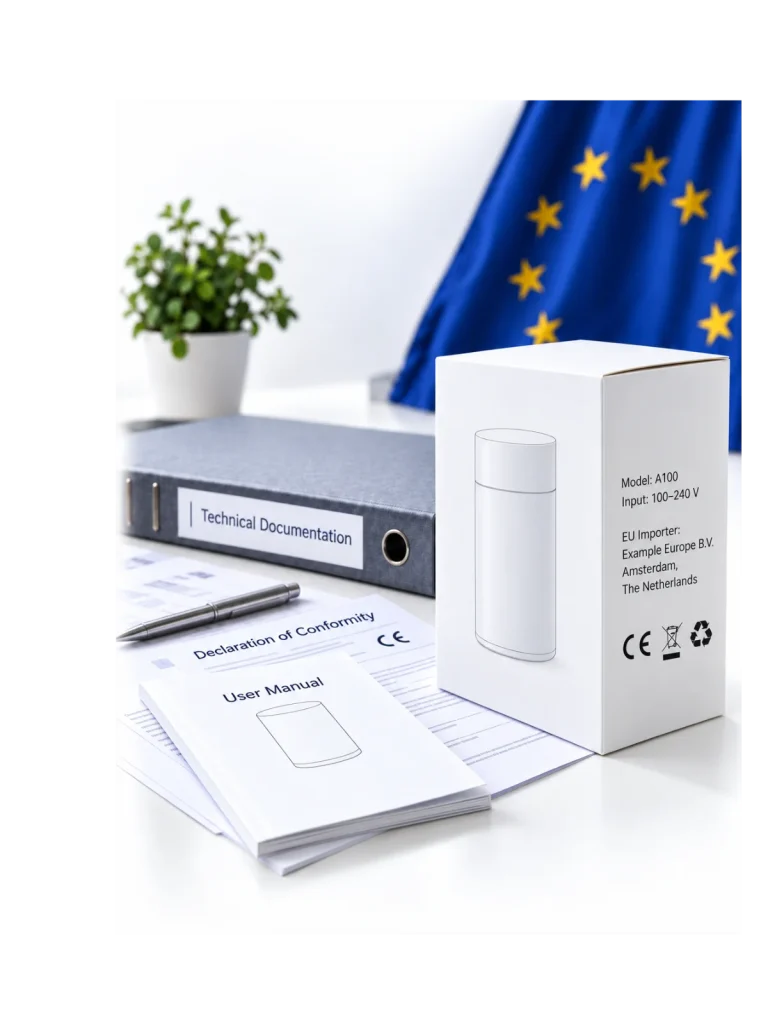
Different EU rules may apply depending on what the product is, how it is used and the risks involved. Relevant requirements can cover safety, materials, electrical characteristics, chemicals, labelling and other product-specific obligations.

CE Marking Where Required
CE marking applies only to products covered by EU legislation that specifically requires it. Many consumer products do not require CE marking but must still comply with applicable safety and product requirements.

EU-Wide and National Rules
Many product requirements are harmonised across the EU, but some areas may still be subject to national rules. Labelling, packaging, testing or other requirements can therefore require additional checks depending on the product and destination.
how we HELP
How We Support EU Compliance
EU product compliance can involve different requirements depending on the product. We help turn those requirements into a clear, practical compliance plan.
Requirements & Gap Analysis
We identify the requirements that may apply to your product, review the available information and highlight potential compliance gaps.
Labels & Documentation
We review product labelling, packaging, instructions and supporting documentation against the applicable requirements.
Laboratory Testing Support
Where testing may be required, we help define the scope, review existing test reports and coordinate with laboratories when needed.
Market Access Support
We connect the different compliance steps and help define the practical actions needed before placing your product on the EU market.
SELLING INTO THE EU
Selling in the EU from Outside the EU
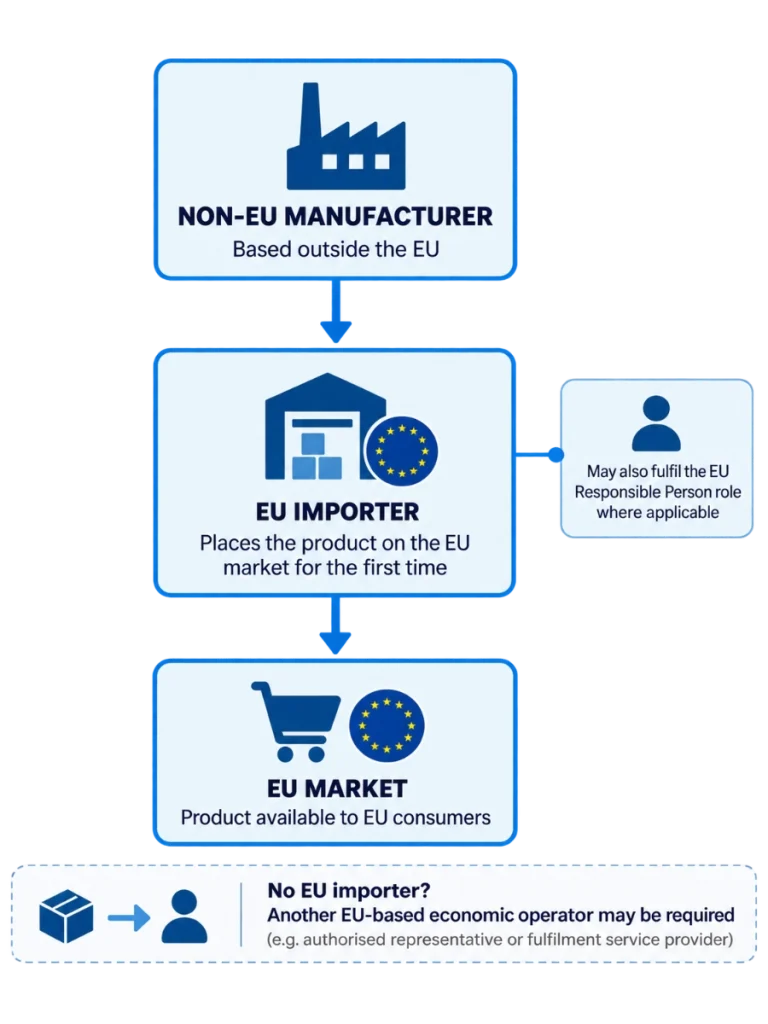
If your business is based outside the European Union, your role as manufacturer does not disappear when your product enters the EU.
Depending on how the product reaches the market and which legislation applies, an EU importer or another EU-based economic operator may also have specific compliance responsibilities.
01
Non-EU Manufacturer
A business that manufactures a product, or has it designed or manufactured, and sells it under its own name or trade mark remains the manufacturer even when it is based outside the EU.
02
EU Importer
When a product from a non-EU country is first placed on the EU market by an EU-based business, that business acts as the importer and has its own compliance obligations.
03
EU Responsible Person
Where an EU-based responsible economic operator is required, the importer may fulfil this role. If there is no importer, another EU-based operator may need to perform these tasks, depending on the applicable legislation and supply chain.
04
Product & Traceability Information
Manufacturer, importer or responsible person details may need to appear on the product, packaging or accompanying documentation, together with the required product identification and other traceability information.
The exact responsibilities depend on the product, applicable legislation and how the product is supplied to the EU market.
EU COMPLIANCE FRAMEWORKS
Key EU Regulatory Areas
EU requirements vary by product type, characteristics and intended use. Some of the regulatory areas we commonly review include:
General Product Safety
GPSR
General safety, traceability and economic operator requirements that may apply to consumer products placed on the EU market.
Learn more ➞
Chemicals & Materials
REACH
Chemical restrictions, substance requirements and related information obligations that may apply to products, materials and components.
Learn more ➞
Packaging & Sustainability
PPWR
EU packaging requirements covering areas such as packaging design, composition, labelling and environmental obligations.
Ecodesign & Product Data
ESPR & DPP
New EU ecodesign requirements and Digital Product Passports are being introduced progressively for selected product groups.
Learn more ➞
Other EU requirements may apply depending on the product, materials, intended use and supply chain.
EU COMPLIANCE FAQ
Frequently Asked Questions
Common questions about CE marking, EU importers, responsible persons, testing and product requirements across the European Union.
READY FOR THE EU MARKET?
Planning to sell your product in the EU?
We can help you identify the applicable requirements, review your documentation and define the practical steps needed for EU market access.
We normally reply within one business day.