From 27 September 2026, businesses selling consumer goods to consumers in the EU will face new requirements for communicating guarantee information.
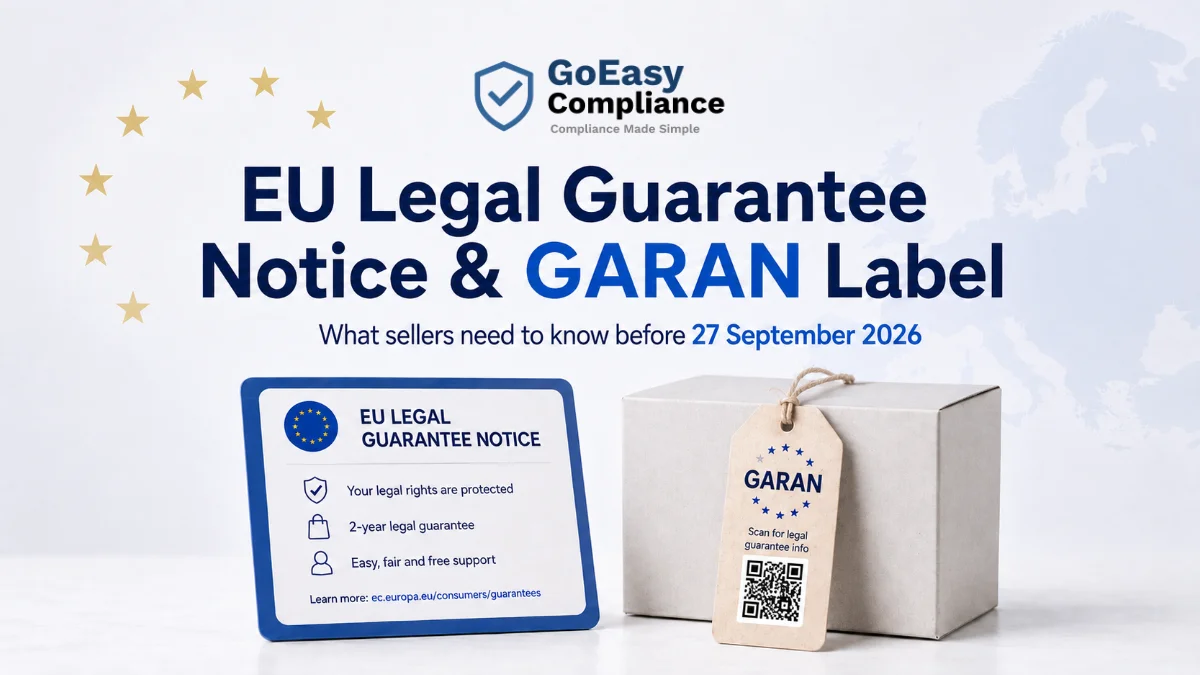
Two harmonised tools are at the centre of the changes: the EU Legal Guarantee Notice, which reminds consumers about their legal guarantee rights, and the GARAN label, which identifies certain products covered by a producer’s commercial guarantee of durability.
They may look like two new labels, but they work very differently. The Legal Guarantee Notice is a general seller information requirement. The GARAN label only applies to products covered by a qualifying commercial guarantee of durability.
The changes come from Directive (EU) 2024/825, which amended the Consumer Rights Directive, while Commission Implementing Regulation (EU) 2025/1960 establishes the design and content of the harmonised notice and GARAN label. The new requirements apply from 27 September 2026.
What Changes on 27 September 2026?
The new system introduces two separate consumer-information tools. Understanding the difference is the first step before changing a website, store display, product label or packaging.
| Requirement | Level | Main responsibility | When required |
|---|---|---|---|
| EU Legal Guarantee Notice | Shop or sales environment | Seller | For consumer goods within scope |
| GARAN label | Specific product | Producer information and seller display | Only for a qualifying producer durability guarantee |
The EU is not introducing a universal GARAN product label for every product sold in Europe. The Legal Guarantee Notice provides general information about consumers’ existing legal rights, while GARAN highlights a specific additional durability commitment made by a producer.
What Is the EU Legal Guarantee Notice?
Consumers buying goods in the EU already benefit from a legal guarantee of conformity. Under EU rules, this protection has a minimum duration of two years, although national law can provide longer periods.
The EU Legal Guarantee Notice does not create a new two-year warranty. Its purpose is to make consumers more aware of the legal rights they already have.
From 27 September 2026, sellers must use the official harmonised notice to provide the required reminder prominently. The notice explains the main elements of the legal guarantee, including that the duration can vary by country, common situations in which consumers can rely on their rights, possible remedies and where to find further information.
Who Needs to Display the EU Legal Guarantee Notice?
The requirement is relevant to sellers of consumer goods in transactions covered by EU consumer rights rules. In practice, this can include physical retailers, ecommerce businesses and other businesses selling goods directly to consumers.
The rules are focused on consumer sales. Businesses that operate both B2C and B2B channels should distinguish between those activities rather than automatically treating every transaction in the same way.
Companies selling across several EU countries should also consider the national rules implementing Directive (EU) 2024/825, particularly where national consumer law provides longer legal guarantee periods or other country-specific requirements.
Where Should the Legal Guarantee Notice Be Displayed?
The notice must be displayed prominently, but this should not be confused with a requirement to place a new label on every individual product or package. The European Commission describes the Legal Guarantee Notice as operating at shop level and gives several possible display locations.
Physical stores
In a physical sales environment, the notice may be displayed prominently on a wall, near the checkout or in another location where consumers can clearly see it.
- The printed notice cannot be smaller than A4.
- It can be displayed in colour or black and white.
- The official notice must remain legible and the QR code must remain scannable.
The Commission’s practical guidelines also give examples such as the entrance door, customer-service areas and other prominent store locations. The appropriate placement will depend on the layout of the sales environment.
Online stores
For ecommerce, the notice must also be presented prominently. The rules do not prescribe every individual product page as the only possible location.
The Commission’s practical guidelines give examples including the product catalogue page, the website header and the checkout. In these examples, a short message such as ‘Your legal guarantee rights’ can reveal the full notice after the first click or mouse-over.
- The online version must be in colour.
- The notice must be legible at its default display size.
- A clickable link to the same destination as the QR code should be available.
- The Commission’s practical guidance also states that the notice should be included in the confirmation email.
These examples are not exhaustive. The key point is that businesses should review the overall customer journey and make sure the harmonised notice is presented prominently rather than assuming that one specific website location is the only compliant approach.
Can You Modify the Legal Guarantee Notice?
No. The official design is harmonised and its fixed elements cannot be edited.
Commission Implementing Regulation (EU) 2025/1960 sets the design and technical requirements, including the QR code, colours and permitted physical and digital formats. The European Commission has also published official high-resolution files in all EU languages.
Businesses should therefore use the official artwork instead of recreating the notice, changing its colours, cropping it or adapting it to match their own brand design.
What Is the EU GARAN Label?
The GARAN label has a different purpose. It identifies a specific product for which the producer offers a qualifying commercial guarantee of durability.
This is an additional commercial commitment from the producer. It does not replace the consumer’s legal guarantee rights.
The GARAN label is intended to help consumers identify products whose producers commit to maintaining the product’s required functions and performance through normal use for the stated guarantee period.
When Is the GARAN Label Mandatory?
The GARAN label is not mandatory for every product sold in the EU.
It applies when the producer offers a commercial guarantee of durability that meets all three of the following conditions:
- It is provided at no additional cost to the consumer.
- It covers the entire good, rather than only a specific component.
- It has a duration of more than two years.
When those conditions are met, use of the harmonised GARAN label is mandatory.
A useful way to understand the rule is this: offering this type of commercial durability guarantee is voluntary, but using GARAN becomes mandatory when the producer offers a guarantee that meets the qualifying conditions.
The Directive also states that the seller’s information obligation arises where the producer makes the relevant guarantee information available to the trader. The trader is not expected to actively search for that information, for example by checking product-specific websites.
Legal Guarantee vs Commercial Guarantee vs GARAN
These concepts are easy to mix up. The practical differences are:
| Legal guarantee of conformity | Commercial guarantee | GARAN qualifying durability guarantee | |
|---|---|---|---|
| Source | Consumer law | Voluntary commercial commitment | Voluntary producer commitment |
| Mandatory existence? | Yes, where applicable | No | No |
| Duration | At least 2 years under EU rules; national law may be longer | Depends on the offer | More than 2 years |
| Who provides it? | Seller is liable to the consumer under the applicable rules | Seller or producer, depending on the guarantee | Producer |
| Must cover the entire product? | Governed by legal conformity rules | Depends on the terms | Yes |
| GARAN label used? | No | Not unless the GARAN criteria are met | Yes |
| Replaces legal rights? | Not applicable | No | No |
Producers and sellers can continue to offer other commercial guarantees and after-sales services. However, those offers should not confuse consumers about the qualifying durability guarantee represented by GARAN.
What Information Does the GARAN Label Include?
Unlike the Legal Guarantee Notice, GARAN is associated with a specific product. The official label contains fixed elements as well as information that the producer must complete for the relevant guarantee.
- The duration of the durability guarantee in years.
- The producer’s brand or trademark.
- The model identifier.
When printed, the GARAN label cannot be smaller than 95 x 100 mm and may be in colour or black and white. When used online, it must be in colour.
For digital sales, the official framework also allows a nested display format. The simplified nested label can expand to show the full harmonised GARAN label after a click, mouse-over or touch-screen interaction.
Do You Need to Change Your Product Label or Packaging?
Not necessarily. This is likely to be one of the biggest sources of confusion around the new requirements.
For the EU Legal Guarantee Notice
The Legal Guarantee Notice is not a new product conformity label. It is a general consumer-information notice displayed in the sales environment.
A retailer should therefore not assume that every existing product label or package needs to be redesigned simply because the notice becomes mandatory.
For the GARAN label
GARAN operates at product level, but this still does not mean that packaging is the only possible place to display it.
The producer can place the GARAN label directly on the product or its packaging. The rules also contemplate other prominent product-specific display methods, such as alongside the relevant product in a shop or next to the product in an online sales environment.
The right implementation depends on whether GARAN applies at all, the sales channel, how the product is presented, and whether the business acts as producer, seller or both.
What Does This Mean for Ecommerce and Marketplace Sellers?
Online businesses should review how guarantee information appears throughout the customer journey before 27 September 2026.
For the EU Legal Guarantee Notice, the Commission’s examples include website-wide locations such as the catalogue, header and checkout, with the full notice displayed prominently and in colour.
For products covered by a qualifying durability guarantee, the GARAN label must remain clearly associated with the specific product. Commission guidance indicates that it can appear as a product image, a standalone image in the gallery, in the product description or through the nested digital label. It should also be visible before the consumer places the order.
Businesses selling through marketplaces should not simply assume that the platform will resolve every requirement on their behalf. Sellers still need to understand their own role, what information the producer has provided, and how the relevant guarantee information is presented to the consumer.
What Should Businesses Do Before 27 September 2026?
A practical preparation process should include the following steps:
- Identify your role. Determine whether you act as seller, producer or both for the relevant products.
- Review your sales channels. Identify where consumer guarantee information is currently displayed in physical stores, ecommerce sites and marketplace listings.
- Prepare the EU Legal Guarantee Notice. Obtain the official artwork in the appropriate language and format and decide where it will be displayed prominently.
- Review commercial guarantees. Identify whether any producer guarantees are free of charge, cover the entire product and last more than two years.
- Identify products requiring GARAN. Do not apply GARAN universally. Determine which products actually meet the criteria.
- Check product-specific information. Where GARAN applies, confirm the guarantee duration, producer brand or trademark and model identifier.
- Review the commercial guarantee statement. Where a commercial guarantee is offered, make sure the consumer receives the required terms in a durable form no later than delivery.
- Coordinate implementation. Compliance, ecommerce, retail, customer service and marketing teams may all need to be involved.
- Keep records of the review. Document how the requirements were assessed and implemented, especially where several brands, product ranges or sales channels are involved.
Businesses operating in more than one EU country should also check the applicable national consumer-law position. The harmonised notice does not remove all differences between national legal guarantee regimes.
How GoEasy Compliance Can Help
New regulatory requirements often look simple until a business has to determine which obligation applies, to which product, in which sales channel and to which economic operator.
GoEasy Compliance supports manufacturers, brands, importers and sellers with practical product compliance reviews for the EU and other international markets.
We can help businesses identify applicable requirements, review product and consumer information, assess labelling and documentation gaps, and define practical next steps before regulatory changes take effect.
The objective is not to add another label everywhere. It is to understand what actually applies and implement the requirement in the right place.
Frequently Asked Questions
Is the EU Legal Guarantee Notice mandatory?
Yes. From 27 September 2026, sellers of consumer goods within scope must use the harmonised notice to provide consumers with the required reminder about their legal guarantee rights.
Is the GARAN label mandatory for every product?
No. GARAN applies only when the producer offers a commercial guarantee of durability that is free of charge, covers the entire good and lasts for more than two years.
Does GARAN need to appear on the product packaging?
Not necessarily. GARAN must be clearly associated with the relevant product, but packaging is not the only possible display method. Depending on the sales environment, it may also be displayed on the product, alongside it or in an appropriate product-specific digital format.
Does the EU Legal Guarantee Notice need to appear on every ecommerce product page?
The rules require prominent display, but they do not make every individual product page the sole prescribed location. The Commission gives examples including the product catalogue, website header and checkout, and describes a general reminder on the seller’s website as a possible approach.
Does GARAN replace CE marking or other product labels?
No. GARAN communicates information about a qualifying commercial guarantee of durability. It does not replace CE marking or any safety, conformity, traceability, environmental or sector-specific labelling requirements that may separately apply to a product.
Does the new requirement apply to B2B sales?
The requirements discussed here form part of EU consumer rights legislation and concern sales to consumers. Businesses operating both B2C and B2B channels should distinguish between the two.
When do the new Legal Guarantee Notice and GARAN rules apply?
The new requirements apply from 27 September 2026. Commission Implementing Regulation (EU) 2025/1960 uses the same application date as the measures transposing Directive (EU) 2024/825.
Prepare Before the Deadline
The new EU guarantee information requirements do not mean that every business needs to redesign every package before September.
Sellers should understand how the EU Legal Guarantee Notice must be integrated into their sales environment, while producers and sellers should determine whether any products are subject to the GARAN label requirements.
The practical question is not simply, ‘Do I need the new EU label?’ It is, ‘Which of these requirements applies to my business, my products and the way I sell them?’
Identifying that early can reduce unnecessary changes and make implementation much easier before 27 September 2026.
Need help reviewing your EU product compliance requirements? GoEasy Compliance can help you identify applicable requirements, review product information and documentation, identify compliance gaps and define practical next steps for placing products on the EU market.
Disclaimer: This article provides general information and does not constitute legal advice. Requirements may vary depending on the product, business role, sales model, target country and applicable national legislation.