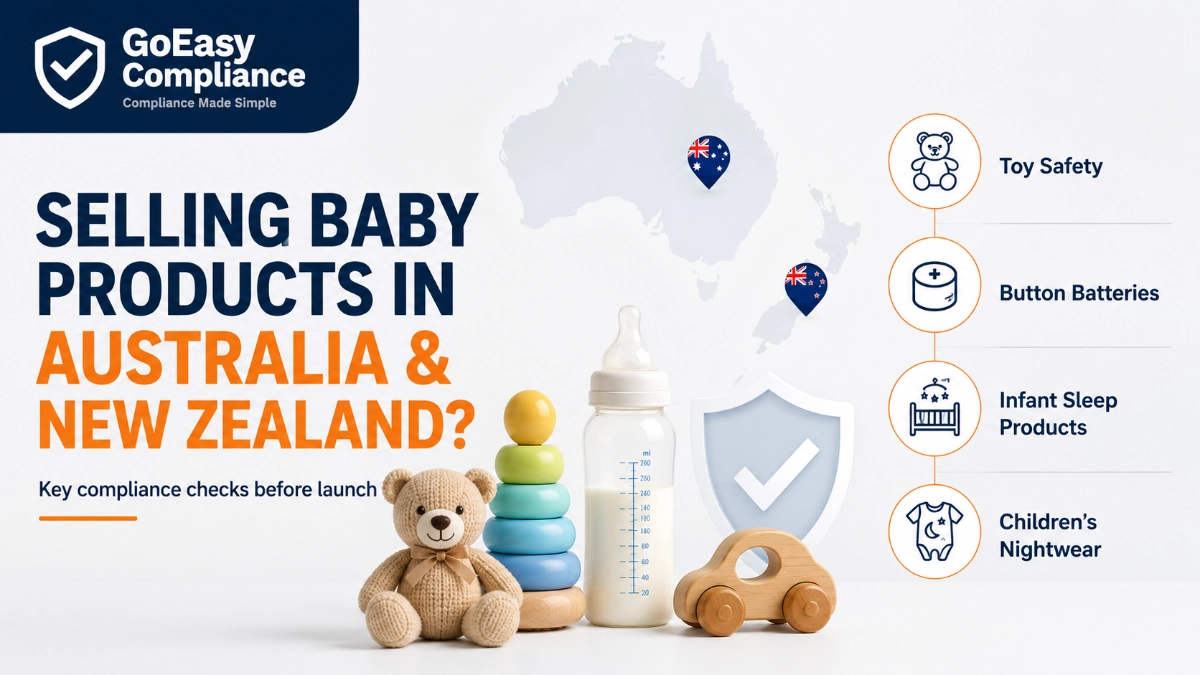
For global brands and ecommerce sellers, navigating Amazon Australia baby product compliance is a critical step when expanding into Australia and New Zealand. However, product compliance in these markets should not be treated as a simple copy and paste exercise from the EU, UK or US.
Baby products, toys, children’s clothing, nursery furniture, sleep products and products with button batteries may be subject to specific safety standards, warning requirements, testing expectations and documentation checks.
For Amazon sellers, this matters because a product can be commercially ready but still fail at the compliance stage. Missing test reports, incorrect warnings, unsupported age grading or incomplete product documentation can lead to delays, listing reviews, suppressed ASINs or enforcement risk.
This article explains key compliance areas to review before selling baby products on Amazon Australia or into the New Zealand market.
Why Australia and New Zealand Need Their Own Compliance Review
Existing EU, UK or US compliance documents may be useful, but they are not always enough.
A CE test report, CPSC test report or UKCA document may help show that a product has already been assessed against recognised standards. However, the key question is whether those documents match the mandatory requirements that apply in Australia or New Zealand.
This depends on the product type, intended age, design, materials, battery type, warnings, packaging, instructions and sales channel.
For baby and children’s products, sellers should review the applicable requirements before listing, importing or sending stock to fulfilment.
1. Toys for Children Up to and Including 36 Months
Products intended or suitable for children up to and including 36 months are treated with particular care.
The issue is not only what the seller says the product is. Regulators and marketplaces may also look at the product design, packaging, marketing images, age claims, colours, characters and intended use.
For young children, small parts are a major risk. A toy, or a detachable part of a toy, must not create a choking or swallowing hazard after the relevant tests. This can include drop, tension, bite or other mechanical tests depending on the applicable standard.
A common mistake is assuming that a product is not a toy because it has a functional purpose. In practice, if the product is designed, labelled or marketed as a plaything for young children, toy safety requirements may still apply.
Before listing, sellers should check:
- Intended age range.
- Whether the product is a toy, a baby article, apparel, furniture or another category.
- Whether any parts can detach during normal or foreseeable use.
- Whether the existing test report covers the correct version of the product.
- Whether the report covers the applicable standard and clauses for Australia or New Zealand.
2. Products With Button or Coin Batteries
Button and coin batteries are a high priority safety issue, especially for products used around children.
Baby monitors, musical toys, light up products, thermometers, remote controls, night lights and novelty items may contain button or coin batteries. If the battery compartment is accessible, the product can create a serious ingestion risk.
For Australia, products containing button or coin batteries generally need secure battery compartments, appropriate warnings and compliance testing. The compartment should be designed so that young children cannot easily access the battery during normal use or foreseeable misuse.
Sellers should not assume that a product is safe just because the battery is small, pre installed or hidden inside the product. The battery design, fastening method, warning labels, packaging and instructions all need to be reviewed.
For Amazon sellers, button battery documentation is especially important because marketplace compliance checks may request evidence before allowing a listing to remain active.
3. Infant Sleep Products and Inclined Baby Products
Infant sleep products are another sensitive category in Australia.
This can include products such as bassinets, cradles, co sleepers, inclined sleepers, household cots and portable folding cots. Some inclined products that are not sold as sleep products can also create compliance issues if marketing images or product claims suggest that a baby may sleep in them.
A key practical point is that product images matter. If a bouncer, rocker or recliner is shown with a sleeping baby, it may be viewed differently from a purely play or soothing product.
Before selling infant sleep or nursery products, sellers should review:
- Whether the product is designed or marketed for sleep.
- Whether the product has an inclined surface.
- Whether the product has required warnings and safety information.
- Whether the instructions cover safe assembly and use.
- Whether the test report matches the final product design.
This category should be reviewed carefully before launch because the consequences of misclassification can be serious.
4. Nursery Furniture and Toppling Risk
Nursery furniture and children’s furniture may also require specific safety information.
In Australia, toppling furniture requirements apply to certain freestanding household furniture. The focus is on making sure consumers receive clear warnings about the risk of furniture tipping over, including warnings at point of sale, online listings, product labels and instructions where applicable.
For baby and children’s products, this can be relevant to items such as chests of drawers, wardrobes, bookcases, storage units and similar furniture used in nurseries or children’s rooms.
Sellers should check whether the product needs:
- Permanent warning labels.
- Online safety warnings.
- Safety information in the instruction manual.
- Anchoring or installation guidance.
- Clear assembly and use instructions.
This is an area where sellers often focus only on the physical product and forget that online listing information can also be part of compliance.
5. Children’s Nightwear and Sleepwear
Children’s nightwear is another category that should not be treated like ordinary clothing.
Products such as pyjamas, nightdresses, dressing gowns, bathrobes, certain all in one garments and infant sleep bags with sleeves or arm openings may be subject to flammability classification and fire hazard labelling.
This can affect baby pyjamas, sleep sacks, onesies and similar products depending on their design, size and how they are marketed.
Sellers should check:
- Whether the garment is nightwear, sleepwear or limited daywear.
- Whether the product falls within the covered size range.
- Whether the fabric and trims have been assessed.
- Whether the correct fire hazard label is used.
- Whether the label is visible, durable and correctly worded.
A product that looks simple from a fashion perspective can still create a compliance risk if the nightwear labelling is missing or incorrect.
Can You Use EU, UK or US Test Reports?
Sometimes, yes. But they need to be reviewed carefully.
Existing reports may reduce duplicated testing if they cover the right product, the right model, the right materials and a standard that is accepted or relevant for the target market.
However, a report is not automatically valid just because it was issued by a recognised lab. Sellers need to check the scope, standard version, test clauses, product photos, model numbers, age grading, warnings and differences between the tested sample and the product being sold.
This is especially important when using one supplier report for multiple products, variants or markets.
Practical Pre Launch Checklist for Sellers
Before launching baby or children’s products on Amazon Australia or into New Zealand, review these points:
- Confirm the product category and intended age range.
- Check whether the product is a toy, baby article, sleep product, apparel, furniture or electronic product.
- Identify applicable mandatory standards and information requirements.
- Review existing EU, UK, US or supplier test reports.
- Check whether button or coin batteries are included.
- Review packaging warnings, product labels and instruction manuals.
- Check whether online listing warnings are required.
- Prepare a clear documentation file before Amazon requests it.
- Keep product photos, model numbers and test reports consistent.
- Review changes if the supplier modifies the product, materials, batteries or packaging.
How GoEasy Compliance Can Help
GoEasy Compliance helps Amazon sellers, brands, importers and ecommerce companies understand product compliance requirements before launching in new markets.
For Australia and New Zealand market access, we can support with:
- Product classification and applicable requirement research.
- Review of existing test reports and supplier documentation.
- Gap analysis against target market requirements.
- Labelling and warning review.
- Instruction manual review where required.
- Technical documentation support.
- Practical next steps before listing or importing.
We do not promise automatic approval or guaranteed compliance. Instead, we help you identify the likely requirements, understand documentation gaps and reduce avoidable market access risks.
Conclusion
Australia and New Zealand can be valuable markets for baby product sellers, but compliance should be reviewed before launch.
For toys, button battery products, infant sleep products, nursery furniture and children’s nightwear, small details can create big problems. Age grading, warnings, test reports, labels, instructions and online listing information all matter.
Before sending stock or uploading documentation to Amazon, it is worth checking whether your product file is ready for the market you are targeting.
Planning to launch baby or children’s products in Australia and New Zealand? Don’t let compliance gaps slow down your expansion or risk your Amazon account. Contact GoEasy Compliance to review your product documentation before launch.
Ready to bring your product to market with confidence?
Contact GoEasy Compliance today for expert support.