For many companies, product compliance has traditionally focused on the item inside the packaging.
A toy may need mechanical and chemical testing. An electronic product may require electrical safety and electromagnetic compatibility assessments. A food-contact product may need migration testing.
The box, plastic film, insert, blister pack or protective foam around the product is often reviewed much later, or left almost entirely to the packaging supplier.
That approach is becoming increasingly risky.
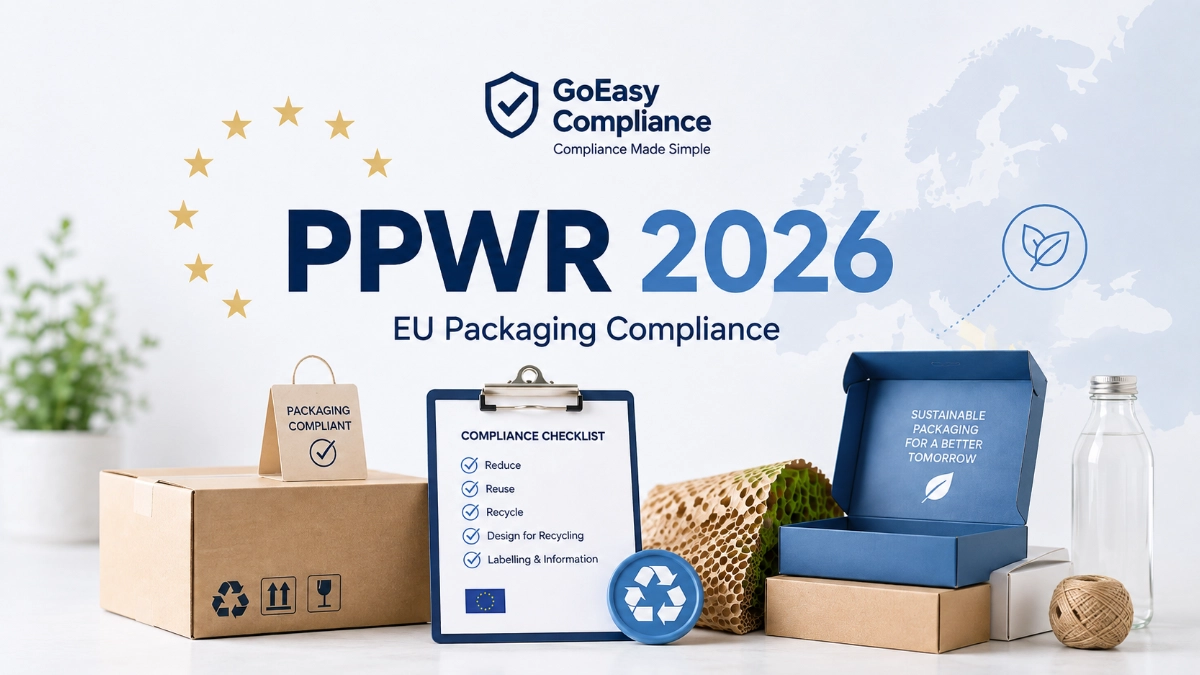
The EU Packaging and Packaging Waste Regulation, Regulation (EU) 2025/40, commonly known as the PPWR, entered into force on 11 February 2025 and has generally applied since 12 August 2026.
It covers packaging of all materials and origins, including sales packaging, grouped packaging, transport packaging and e-commerce packaging.
However, not every PPWR requirement started on 12 August 2026. Some obligations now apply, while important requirements concerning recyclability, harmonised labelling, recycled content and packaging minimisation will be introduced progressively.
For manufacturers, importers, brand owners and companies selling packaged products in the European Union, understanding that timeline is essential.
What Is the PPWR?
The PPWR 2026 replaces the previous Packaging and Packaging Waste Directive with a directly applicable EU Regulation.
It introduces requirements covering areas such as:
- Substances in packaging
- Recyclability
- Recycled content in plastic packaging
- Packaging minimisation
- Reusable packaging
- Harmonised labelling
- Technical documentation
- Traceability
- Extended producer responsibility
- Environmental claims relating to packaging
Its scope goes beyond waste management.
The PPWR also establishes requirements that packaging must meet before it can be placed on the EU market. This makes packaging increasingly relevant to product compliance and market access, rather than simply a logistics, purchasing or marketing decision.
PPWR Timeline: What Applies Now and What Comes Next?
One of the most important points for businesses is that the PPWR does not introduce every obligation at the same time.
| Requirement | Main application date |
|---|---|
| PPWR generally applies | 12 August 2026 |
| PFAS limits for food-contact packaging | 12 August 2026 |
| Technical documentation and EU Declaration of Conformity for applicable requirements | From 12 August 2026 |
| Harmonised material-composition labelling | From 12 August 2028, or 24 months after the relevant implementing acts enter into force, whichever is later |
| Design-for-recycling requirements | From 1 January 2030, or later where the Regulation links application to the relevant secondary legislation |
| Packaging weight and volume minimisation | 1 January 2030 |
| Minimum recycled-content targets for certain plastic packaging | From 1 January 2030 |
| Maximum 50% empty-space ratio for certain grouped, transport and e-commerce packaging | From 1 January 2030, or three years after the relevant implementing act enters into force, whichever is later |
Businesses should therefore distinguish between:
- Requirements that need attention now.
- Requirements that require preparation for 2028 to 2030.
- Requirements whose detailed technical methodologies depend on further EU legislation.
What Changed from 12 August 2026?
PFAS Restrictions for Food-Contact Packaging
From 12 August 2026, food-contact packaging cannot be placed on the EU market where it contains PFAS at or above the limits established by the PPWR.
The Regulation establishes three main thresholds:
- 25 ppb for any individual PFAS measured through targeted PFAS analysis, excluding polymeric PFAS from the quantification.
- 250 ppb for the sum of PFAS measured through targeted analysis, where applicable following prior degradation of precursors, again excluding polymeric PFAS from the quantification.
- 50 ppm for PFAS, including polymeric PFAS.
Where total fluorine exceeds 50 mg/kg, additional evidence may be required to establish the amount of fluorine attributable to PFAS and to non-PFAS substances for the purposes of preparing the technical documentation.
This can be particularly relevant to packaging such as:
- Food wrappers
- Grease-resistant paper
- Coated cardboard
- Food pouches
- Liners
- Bags used for food or animal feed
- Other packaging intended to come into contact with food
The restriction specifically concerns food-contact packaging. It should not automatically be extended to every exterior box associated with food, kitchenware or other consumer products.
Companies should therefore determine whether the packaging has an intended food-contact function and whether the information available from suppliers provides adequate supporting evidence.
Heavy Metal Limits
Packaging and packaging components are subject to a combined maximum concentration of 100 mg/kg for:
- Lead
- Cadmium
- Mercury
- Hexavalent chromium
This requirement can be relevant to packaging materials, inks, coatings, pigments, printed components and certain recycled materials.
A generic supplier statement describing packaging as “environmentally friendly” or “sustainable” is not evidence of regulatory compliance.
Depending on the material and available information, appropriate evidence may include material specifications, supplier declarations, chemical information or test reports.
Technical Documentation and the EU Declaration of Conformity
One of the most significant practical changes for businesses is the formal conformity documentation framework for packaging.
Before placing packaging on the market, manufacturers must carry out the applicable conformity assessment and prepare the required technical documentation.
Where compliance with the applicable PPWR requirements has been demonstrated, the manufacturer must draw up an EU Declaration of Conformity.
Technical documentation should make it possible to assess whether the packaging complies with the applicable requirements and may include, where relevant:
- A general description of the packaging and its intended use
- Packaging drawings and specifications
- Materials and components
- Supplier documentation
- Applicable standards or technical specifications
- Assessments and calculations
- Chemical compliance evidence
- Test reports
- Information supporting relevant environmental claims
- The EU Declaration of Conformity
The PPWR does not mean that a technical file must physically travel with every shipment.
Instead, the documentation must be prepared and available to the relevant authorities when required.
Manufacturers must retain the technical documentation and EU Declaration of Conformity for:
- Five years for single-use packaging
- Ten years for reusable packaging
Importers also have obligations to verify that the required conformity assessment and documentation have been completed and to ensure that the relevant documentation can be made available to authorities.
Packaging Identification and Economic Operator Information
The PPWR also introduces traceability obligations.
Packaging must carry a type, batch or serial number, or another element allowing it to be identified. Where the nature or size of the packaging does not allow this information to appear directly on it, the information may be provided through an accompanying document.
Manufacturers must also provide identifying and contact information, including their name or registered trademark and postal address.
Importers have corresponding identification obligations.
Businesses should therefore review how these packaging-specific requirements interact with the information already appearing on the product, retail packaging and accompanying documentation.
Who Is Responsible for Packaging Compliance?
Determining responsibility under the PPWR is not always as simple as identifying the factory that physically produced the box, bottle or bag.
Depending on the supply chain, the manufacturer for PPWR purposes may be the company that has packaging or a packaged product designed or manufactured under its own name or trademark.
For sales and grouped packaging, the company completing the final packaging process and filling the packaging with the product may also play a central role in determining responsibility.
The correct assessment can depend on factors including:
- Who determined the packaging design and specifications
- Whose name or trademark appears on the product or packaging
- Who fills or seals the packaging
- Where the packaging supplier is established
- The size and status of the companies involved
- Who first places the packaging or packaged product on the EU market
Responsibilities should therefore be assessed according to the actual supply chain rather than assumed based only on who purchased the packaging.
Manufacturer vs Producer: Why the Difference Matters
Another potential source of confusion under the PPWR is the difference between a manufacturer and a producer.
These terms do not necessarily refer to the same company.
The manufacturer is primarily linked to conformity obligations concerning the packaging itself, including applicable sustainability requirements, conformity assessment and technical documentation.
The producer, in the context of extended producer responsibility, is the economic operator responsible for relevant EPR obligations in a Member State, which may include registration, reporting and financing the management of packaging waste.
Depending on the business model, one company may hold both roles, or different companies may be responsible for each.
For businesses selling across several EU Member States, this distinction becomes particularly important because EPR obligations can also involve national registrations and reporting requirements.
Which Important Requirements Apply Later?
Harmonised Packaging Labelling
The new harmonised EU material-composition label does not generally become mandatory in August 2026.
The PPWR provides for its application from 12 August 2028 or 24 months after the relevant implementing acts enter into force, whichever is later.
The harmonised system will use pictograms intended to help consumers identify packaging materials and sort packaging waste correctly.
Businesses planning packaging artwork changes should therefore monitor the development and application of the harmonised requirements rather than relying on draft symbols or assumptions about the final system.
Design for Recyclability
The PPWR introduces a future design-for-recycling framework under which packaging recyclability will be assessed according to performance criteria.
The first major design-for-recycling requirements are scheduled from 2030, with detailed criteria and methodologies to be established through secondary EU legislation.
This means companies may not yet have every technical element needed for the future assessment.
However, packaging decisions made today can affect whether future redesigns, material substitutions or supplier changes will be required.
Packaging Minimisation
From 1 January 2030, packaging must be designed so that its weight and volume are reduced to the minimum necessary to ensure its functionality.
Packaging features intended only to increase the perceived size of a product, such as unnecessary layers, double walls or false bottoms, will generally be restricted, subject to the conditions and exceptions established by the Regulation.
Manufacturers will need to be able to support why the chosen packaging design is necessary.
This may involve assessments, calculations, studies, simulations or test results demonstrating that further reductions could compromise packaging functionality or product protection.
The 50% Empty-Space Rule for E-Commerce and Transport Packaging
The PPWR also introduces a specific rule targeting excessive empty space.
For grouped packaging, transport packaging and e-commerce packaging, the maximum empty-space ratio will generally be 50% from 1 January 2030, or three years after the relevant implementing act enters into force, whichever is later.
The European Commission is required to establish the calculation methodology through an implementing act.
Importantly, materials used to fill empty space, such as air cushions, bubble wrap, foam, paper filling or expanded polystyrene, are treated as empty space for this calculation.
Sales packaging is treated differently. Rather than applying the same fixed 50% threshold, the PPWR requires empty space in sales packaging to be reduced to the minimum necessary to ensure packaging functionality, including protection of the product.
For e-commerce businesses and brands shipping directly to consumers, packaging efficiency will therefore become an increasingly important compliance consideration.
How Can the PPWR Affect Different Product Categories?
Food and Food-Contact Products
Food-contact packaging is one of the most immediately affected areas because the PFAS limits have applied since 12 August 2026.
Companies should review coatings, barriers, liners, wrappers and grease-resistant materials, together with the supporting evidence available from packaging suppliers.
Other EU food-contact material requirements may also apply separately.
Toys, Baby Products and Consumer Goods
Boxes, blister packs, plastic windows, printed packaging and protective inserts may need to be reviewed for substances, traceability and supporting documentation.
Packaging compliance should be considered separately from the safety assessment of the product inside it.
A compliant toy or baby product does not automatically mean that its packaging meets all applicable requirements.
Electronics and E-Commerce Products
Consumer electronics frequently use several packaging components, including:
- Retail boxes
- Plastic bags
- Cable ties
- Protective films
- Moulded inserts
- Foam
- Transport cartons
- E-commerce delivery packaging
These components may involve different materials, manufacturers and suppliers.
Electronics and e-commerce businesses should also prepare for future requirements concerning packaging minimisation, empty space and harmonised labelling.
What Should Businesses Review Now?
1. Map Your Packaging Portfolio
Identify the sales, grouped, transport and e-commerce packaging formats used for products placed on the EU market.
2. Identify the Relevant Economic Operators
Determine who may act as the manufacturer, importer and producer for each packaging flow.
Do not assume these roles solely from existing product compliance arrangements.
3. Collect Supplier Documentation
Request relevant information such as:
- Material specifications
- Material composition
- Component information
- Chemical declarations
- Existing test reports
- Supplier compliance declarations
The evidence required will depend on the packaging and applicable requirements.
4. Review Food-Contact Packaging
Determine whether the PFAS restrictions apply and whether the available supplier information provides adequate evidence.
5. Review Heavy Metal Compliance
Check the evidence supporting compliance with the combined 100 mg/kg limit for lead, cadmium, mercury and hexavalent chromium.
6. Organise Technical Documentation
Establish a structured system for packaging specifications, supplier evidence, conformity assessments and EU Declarations of Conformity.
7. Review Packaging Environmental Claims
Claims such as:
- “Recyclable”
- “Reusable”
- “Compostable”
- “Made from recycled material”
should not be treated merely as marketing language.
Claims concerning packaging properties regulated by the PPWR need to be specific and supported by appropriate evidence.
8. Plan for Later PPWR Requirements
Compliance preparation should not stop with August 2026.
Businesses should monitor forthcoming requirements and secondary legislation relating to:
- Harmonised labels
- Recyclability
- Recycled content
- Packaging minimisation
- Empty-space calculations
- Reuse obligations
Packaging decisions made today can create compliance work later.
How GoEasy Compliance Can Help
GoEasy Compliance supports manufacturers, importers, brands and sellers in understanding how packaging requirements interact with their wider product compliance obligations.
Our support can include:
- Identification of applicable PPWR requirements
- Packaging classification
- Assessment of manufacturer, importer and producer roles
- Packaging compliance gap analysis
- Supplier documentation review
- Technical documentation support
- EU Declaration of Conformity support
- Testing coordination where testing is necessary
- Packaging artwork and labelling review
- Practical next steps for EU market access
The exact requirements and evidence needed will depend on the packaging type, material, intended use, supply chain, product category and documentation already available.
Packaging Compliance Is Now Part of the Product Compliance Conversation
The PPWR does not make every sustainability requirement mandatory at the same time.
But since 12 August 2026, the new regulatory framework is no longer simply something businesses can prepare for in the future.
Packaging needs to be considered as part of the compliance process.
Manufacturers, importers and brands should identify their packaging formats, clarify their responsibilities, review supplier evidence and prepare the documentation required for the obligations that now apply.
At the same time, businesses should begin preparing for the later requirements covering recyclability, harmonised labelling, recycled content, packaging minimisation and excessive empty space.
GoEasy Compliance helps companies identify applicable packaging requirements, review existing documentation and identify potential compliance gaps before products are placed on the EU market.
Need help understanding what the PPWR means for your products and packaging? Contact GoEasy Compliance to discuss your packaging portfolio and EU market access requirements.
This article provides general regulatory information and does not constitute legal advice. Applicable requirements may vary depending on the packaging type, material, intended use, supply chain, economic operator role, product category and Member State obligations.
Ready to bring your product to market with confidence?
Contact GoEasy Compliance today for expert support.